Food Safety Culture Plan Builder
Free food safety culture tool: assess maturity across the five GFSI dimensions and build the plan required by BRCGS clause 1.1.2 and FSSC 22000 2.5.8, with measures, review, PDF and Excel.

Auditors no longer ask only whether procedures exist; they ask whether people follow them when no one is watching. BRCGS and FSSC 22000 both require a documented plan to develop the food safety and quality culture, with defined activities, measures and timescales. This tool helps your team assess the culture today and build that plan.
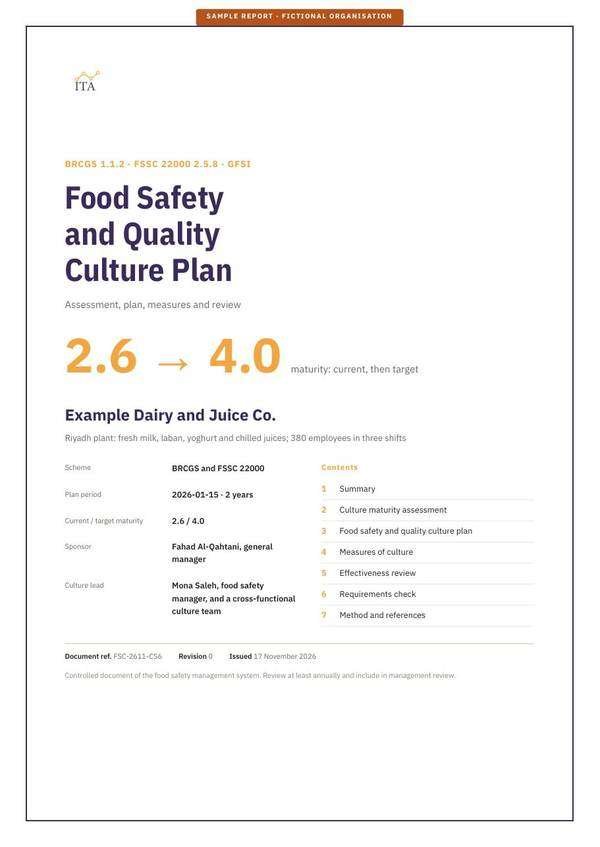
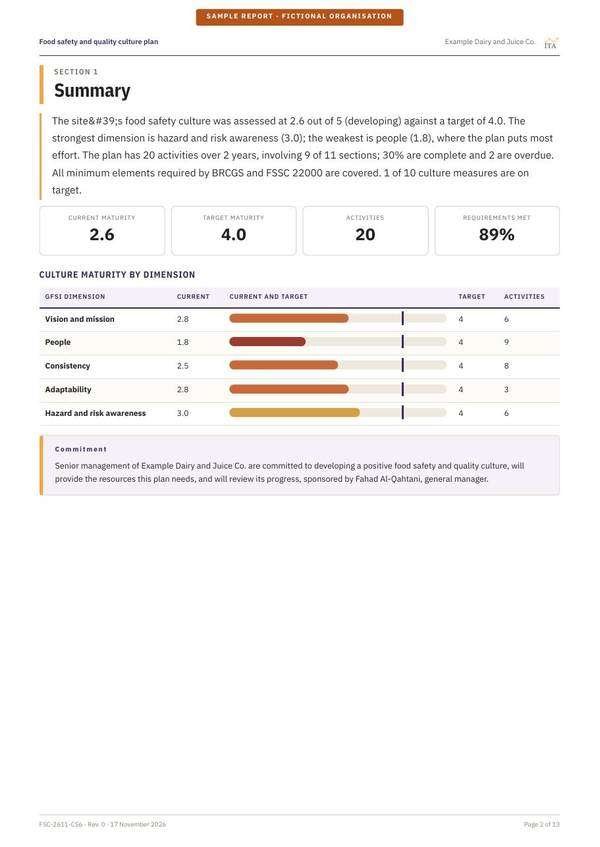
See the report this tool produces
Food safety and quality culture plan for a fictional dairy and juice manufacturer: summary and commitment, maturity across the five GFSI dimensions, the plan by element with sections, owners and timescales, the timeline, culture measures, the effectiveness review and the BRCGS, FSSC 22000 and EU requirements check.
Use the tool below, then press "Download report (PDF)" to get the same report with your own data. The sample uses fictional data.
Assess your food safety culture against the five GFSI dimensions, then build the documented plan that BRCGS clause 1.1.2 and FSSC 22000 additional requirement 2.5.8 require: activities involving every section of the site, with owners, measures and timescales, culture measures with targets, and a review of effectiveness.
- 1Set up the plan
- 2Assess culture maturity (5 GFSI dimensions)
- 3Build the plan: activities, sections, owners, timescales
- 4Set culture measures
- 5Review effectiveness
- 6Check BRCGS, FSSC and EU requirements
Free, no registration. Download a PDF report and an Excel workbook with live formulas, or save your work to a file and continue later.
Loading the food safety culture plan builder…
How the tool works
- Set up the plan. Organisation, site, certification scheme, plan start and period, the senior management sponsor and the culture lead.
- Assess culture maturity. Twenty statements across the five GFSI dimensions (vision and mission, people, consistency, adaptability, hazard and risk awareness), each rated from 1 (initial) to 5 (embedded). Set a target level for each dimension.
- Build the plan. Start from activities suggested for your weakest dimensions, or choose from a library of 31 activities. For each one, record the sections involved, owner, how it is measured, frequency and timescale. The tool shows which minimum elements and which sections are not yet covered.
- Set culture measures. Twelve ready measures, such as survey score, near misses reported, training effectiveness and safe behaviours observed, with baseline, target and latest result.
- Review effectiveness. Record whether each completed activity achieved its purpose and the evidence, with the dates of plan and management reviews.
- Check requirements. Fourteen checks against BRCGS clause 1.1.2, FSSC 22000 additional requirement 2.5.8, EU food law, ISO 22000 and GFSI good practice.
- Download. Enter your email to download the plan as a PDF and an Excel workbook with live formulas, in Arabic or English. Save your work to a file and continue later.
What the standards require
- BRCGS Food Safety Issue 9, clause 1.1.2: senior management define and maintain a clear plan to develop and continually improve the food safety and quality culture. The plan includes defined activities involving all sections of the site that affect product safety, an action plan showing how each activity will be carried out and measured with its intended timescale, and a review of the effectiveness of completed activities. It is reviewed at least annually. BRCGS also offers an optional culture assessment, Culture Excellence, for certified sites.
- FSSC 22000, additional requirement 2.5.8: senior management set food safety and quality culture objectives as part of the management system, covering at least communication, training, employee feedback and engagement, and performance measurement of defined activities in all sections. The objectives are supported by a documented plan with targets and timelines, included in management review and continual improvement. Version 7, published in May 2026 with audits from May 2027, adds sufficient resources and a demonstrable commitment from all personnel. FSSC has also published a guidance document on the topic.
- GFSI: the position paper “A Culture of Food Safety” (2018) describes five dimensions that must be viewed together: vision and mission, people, consistency, adaptability, and hazard and risk awareness. The tool uses them for the maturity assessment.
- EU food law: Regulation (EU) 2021/382 added Chapter XIa on food safety culture to Annex II of Regulation 852/2004: commitment of management and all employees, leadership, hazard awareness, open communication and sufficient resources, with clear roles, control of changes, verification, training and supervision, proportionate to the nature and size of the business.
- Other references: Codex General Principles of Food Hygiene CXC 1-1969 (revised 2020), ISO 22000:2018 clause 5.1 on leadership and commitment, and PAS 320:2023 on developing and sustaining a mature food safety culture.
Related: FSSC 22000 Lead Auditor course, the Food Fraud Vulnerability Assessment and the Gap Assessment Tool.
Frequently asked questions
What is food safety culture?
The shared values, beliefs and norms that affect how people think and behave towards food safety across the whole organisation. In practice it is what people do when no one is checking, and whether they feel able to stop the line or raise a concern.
Is a training plan enough?
No. Auditors look for activities across all the required elements: communication, training, employee feedback, required behaviours and performance measurement, involving every section that affects product safety, with measures and a review of effectiveness.
How long should the plan be?
BRCGS and FSSC do not set a fixed length. Many sites use a one- to three-year plan, reviewed at least annually and included in management review. The tool supports one, two or three years.
How do we measure culture?
Use a mix of leading measures, such as staff survey scores, near misses reported, behavioural observations and training effectiveness, and lagging measures, such as repeat nonconformities and complaints. A rise in near-miss reporting is usually a good sign of trust.
Is my data stored?
Your data stays in your own browser while you work. When you download a file we record your email, name and organisation and your totals, so that we can send you the services and course news you agreed to receive. See our privacy notice.
Does the plan guarantee audit compliance?
No. It is a tool for your team; compliance depends on carrying out the plan and showing evidence of its effect. ITA supports food businesses with culture assessments and audit preparation; contact us.