
Food Defence Threat Assessment (TACCP)
Free TACCP tool: assess 14 process points for deliberate contamination using the FDA three-element method, with key activity types, threat actors, a food defence plan, PDF and Excel.

Food defence protects food from deliberate contamination by people who intend to cause harm, whether a disgruntled employee, an intruder, an extortionist or a cyber attacker. BRCGS, FSSC 22000 V7 and the FDA intentional adulteration rule require a threat or vulnerability assessment and a food defence plan. This tool helps your team assess 14 process points, identify the actionable process steps and choose mitigation strategies.
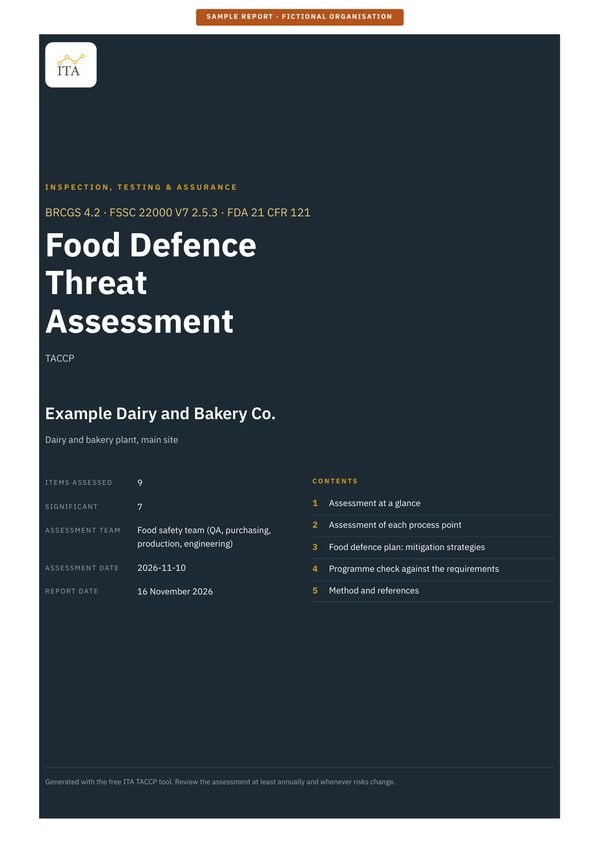
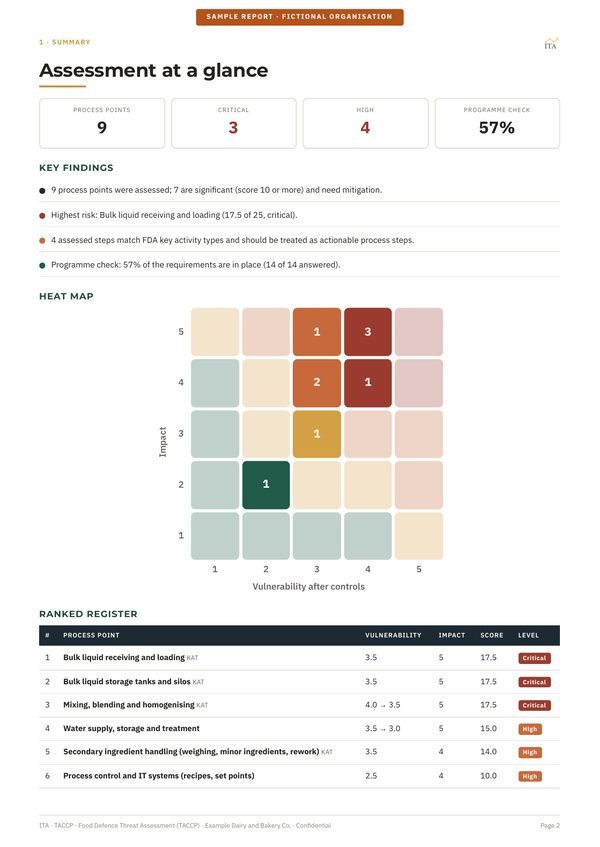
See the report this tool produces
Food defence threat assessment for a fictional dairy and bakery manufacturer: summary, heat map, ranked register of process points with FDA key activity types flagged, threat actors, the food defence plan, the programme check and the method.
Use the tool below, then press "Download report (PDF)" to get the same report with your own data. The sample uses fictional data.
Loading the assessment tool…
How the assessment works
- Choose the process points. From bulk liquid receiving, silos and secondary ingredient handling to mixing, filling, finished goods, dispatch, water, chemical stores and process control systems, or add your own.
- Rate the three fundamental elements. The potential public health impact, the degree of physical access to the product and the ability of an attacker to contaminate it successfully, each from 1 to 5 with a description for every level.
- Identify the threat actors. Insiders, contractors and visitors, external intruders, extortionists or activists, and cyber attackers.
- Record existing controls. Locks and seals, restricted access, CCTV or supervision, the two-person rule, inspection before use, ID and escort, screening and cyber controls. Controls reduce the vulnerability score.
- Get the results. Steps that match FDA key activity types are flagged. You get a ranked register, a 5×5 heat map and a food defence plan with mitigation strategies for each driver and threat actor, owners and dates.
- Check the programme and download. Check 14 programme requirements, then enter your email to download a PDF report and an Excel workbook with live formulas, in Arabic or English.
What the standards and regulations require
- BRCGS Food Safety Issue 9, clause 4.2 (site security and food defence): a documented threat assessment of potential risks to products from deliberate attempts to inflict contamination or damage, controls for sensitive or restricted areas, and review at least annually.
- FSSC 22000 Version 7, additional requirement 2.5.3: a documented threat assessment and a food defence plan with mitigation measures, supported by the food safety management system, prepared by competent people, compliant with legislation and covering the scope; it applies in addition to ISO 22002-100:2025 clause 16.2.
- FDA 21 CFR Part 121 (mitigation strategies to protect food against intentional adulteration): a written food defence plan with a vulnerability assessment using the three fundamental elements, or the key activity types, mitigation strategies for actionable process steps, monitoring, corrective actions, verification and training (21 CFR 121.4).
- ISO 22002-100:2025: the new common prerequisite programme requirements, including food defence, used together with the sector parts.
- Codex and national law: Codex general principles of food hygiene (CXC 1-1969), and national requirements such as SFDA and the Saudi Anti-Commercial Fraud Law, and Egypt’s National Food Safety Authority. Check the requirements of every market you supply.
Also assess the other side of the programme with our Food Fraud Vulnerability Assessment (VACCP) tool, and see the BRCGS Vulnerability Assessment for Food Fraud course and the FSSC 22000 implementation course.
Frequently asked questions
What are FDA key activity types?
FDA identified four activity types that are commonly vulnerable to intentional adulteration: bulk liquid receiving and loading, liquid storage and handling, secondary ingredient handling, and mixing and similar activities. A step that matches one of them can be treated as an actionable process step without a full scoring of the three elements.
Does the FDA rule apply to us?
The intentional adulteration rule applies to facilities that must register with FDA, including many overseas exporters to the USA, with exemptions such as very small businesses and some activities. Check the rule and FDA guidance for your situation.
Do I need to register to use the tool?
No. The assessment and results are free and need no registration. We ask for your email only when you download the PDF report or the Excel file.
Does this tool replace our documented food defence plan?
It supports it. Your plan must be prepared by competent people, reviewed regularly and, under the FDA rule, include monitoring, corrective actions and verification. You can use the downloaded files as the basis after your team reviews and approves them.
Is my data stored?
Your assessment stays in your own browser while you work. When you download a file we record your email, name and organisation and the points you assessed, so that we can send you the services and course news you agreed to receive. See our privacy notice.
Can ITA help us?
Yes. Our consultants help food businesses build and review threat assessments and food defence plans for BRCGS, FSSC 22000 and FDA requirements. Contact us.