
Food Fraud Vulnerability Assessment (VACCP)
Free VACCP tool: assess 22 high-risk materials against six vulnerability factors and your controls, with a ranked register, heat map, mitigation plan, PDF and Excel.

Food fraud is the deliberate substitution, dilution, mislabelling or false claim of food, ingredients or packaging for economic gain. BRCGS, FSSC 22000 V7 and ISO 22002-100 require a documented vulnerability assessment and a mitigation plan. This tool helps your team assess 22 commonly targeted materials, or your own, rank them by risk and decide the preventive measures.
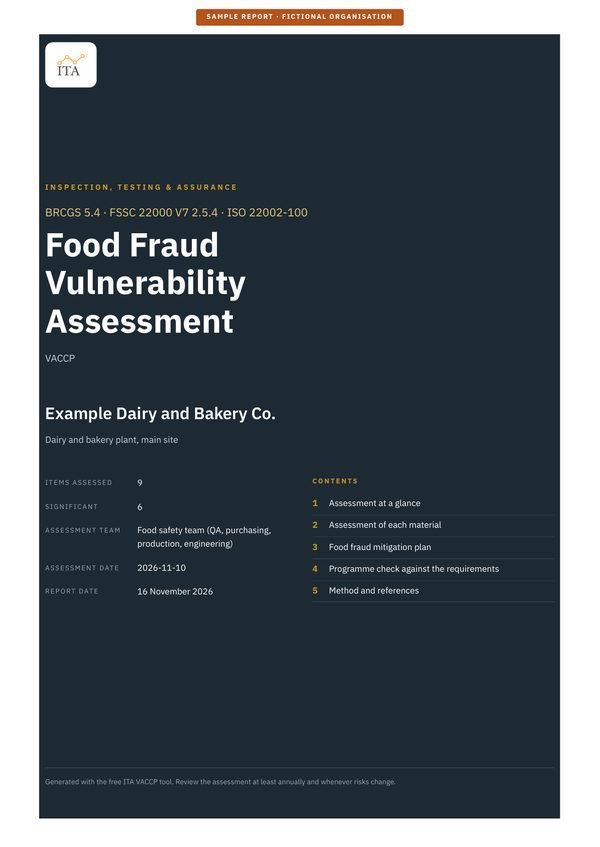
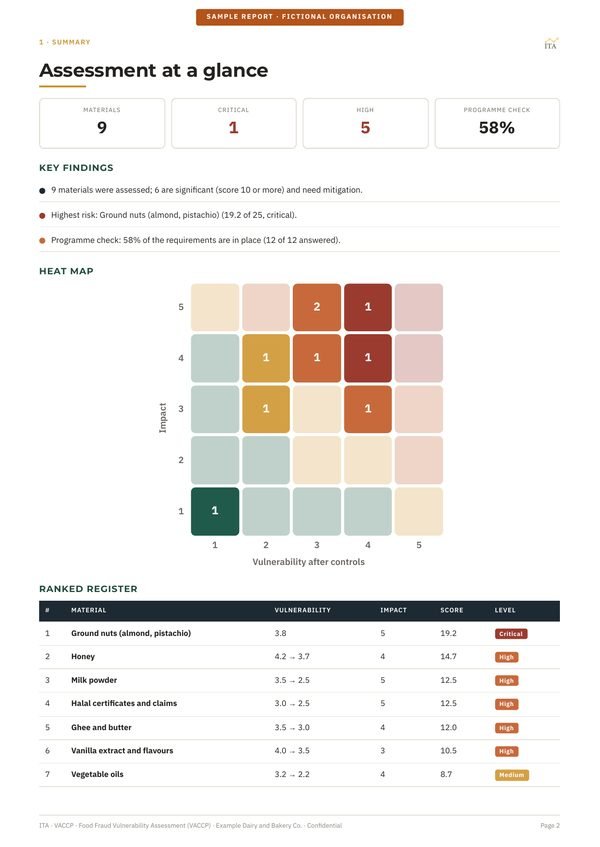
See the report this tool produces
Food fraud vulnerability assessment for a fictional dairy and bakery manufacturer: summary, heat map, ranked register of materials, the assessment of each material with known fraud types, the mitigation plan, the programme check and the method.
Use the tool below, then press "Download report (PDF)" to get the same report with your own data. The sample uses fictional data.
Loading the assessment tool…
How the assessment works
- Choose the materials. Select from 22 materials with a known fraud history, such as olive oil, honey, spices, saffron, milk powder, fish, meat species, rice, fruit juice and halal or organic claims, or add your own. Each shows the known fraud types and useful tests.
- Rate six vulnerability factors. Economic incentive, history of fraud, supply chain complexity, ease of adulteration and difficulty of detection, weakness of supplier assurance and market pressure, each from 1 to 5 with a description for every level.
- Rate the impact. The consumer health impact (for example undeclared allergens or toxic adulterants) and the legal, religious or brand impact.
- Record existing controls. Certification, specifications, certificates of analysis, authenticity testing, traceability and mass balance, supplier audits, market intelligence, direct sourcing and tamper evidence. Controls reduce the vulnerability score.
- Get the results. A ranked register, a 5×5 heat map and a mitigation plan with recommended actions, owners and dates. Items scoring 10 or more are significant and belong in your food fraud mitigation plan.
- Check the programme and download. Check 12 programme requirements, then enter your email to download a PDF report and an Excel workbook with live formulas, in Arabic or English.
What the standards and regulations require
- BRCGS Food Safety Issue 9, clause 5.4 (product authenticity, claims and chain of custody): a documented vulnerability assessment of all food raw materials, reviewed at least annually, and an assurance or testing plan for materials at risk.
- FSSC 22000 Version 7, additional requirement 2.5.4: a documented food fraud vulnerability assessment and a mitigation plan supported by the food safety management system, prepared by competent people, compliant with legislation and kept up to date; it applies in addition to ISO 22002-100:2025 clause 16.3.
- ISO 22002-100:2025: the new common prerequisite programme requirements, including food fraud mitigation, used together with the sector parts (for example ISO 22002-1 for food manufacturing).
- GFSI benchmarking requirements: food fraud vulnerability assessment and mitigation have been required since version 7.
- FDA 21 CFR 117.130: hazards that may be intentionally introduced for economic gain must be considered in the hazard analysis of the preventive controls rule.
- Codex Alimentarius: guidelines on the prevention and control of food fraud developed by the Codex Committee on Food Import and Export Inspection and Certification Systems (CCFICS), together with CXC 1-1969 on food hygiene.
- National law: for example the Saudi Anti-Commercial Fraud Law and SFDA requirements, and Egypt’s Law 1/2017 on the National Food Safety Authority and the anti-fraud law. Check the requirements of every market you supply.
Also assess the other side of the programme with our Food Defence Threat Assessment (TACCP) tool, and see the BRCGS Vulnerability Assessment for Food Fraud course and the FSSC 22000 implementation course.
Frequently asked questions
What is the difference between VACCP and TACCP?
VACCP (vulnerability assessment and critical control points) deals with food fraud, which is economically motivated: the aim is profit, not harm. TACCP (threat assessment and critical control points) deals with food defence, which covers deliberate attacks intended to cause harm, disruption or extortion. Most certified sites need both.
Do I need to register?
No. The assessment and results are free and need no registration. We ask for your email only when you download the PDF report or the Excel file.
Are the default scores correct for my site?
No. They are starting points based on the known fraud history of each material. Your team must adjust every score to your own suppliers, origins, controls and market conditions, and record the evidence.
Does this tool replace our documented assessment?
It supports it. BRCGS and FSSC 22000 require a documented assessment by competent people and regular review. You can use the downloaded report and Excel file as the basis of your documented assessment after your team reviews and approves it.
Is my data stored?
Your assessment stays in your own browser while you work. When you download a file we record your email, name and organisation and the items you assessed, so that we can send you the services and course news you agreed to receive. See our privacy notice.
Can ITA help us?
Yes. Our consultants help food businesses build and review food fraud vulnerability assessments and mitigation plans for BRCGS and FSSC 22000. Contact us.