Environmental Aspects and Impacts Assessment
Free ISO 14001 tool: identify activities, environmental aspects and impacts, evaluate significance, build the register of environmental aspects and the action plan, PDF and Excel.

Every ISO 14001 system rests on one document: the register of environmental aspects. It lists what your activities, products and services do to the environment, the impacts that can follow, and which of them are significant enough to control, monitor and improve. This tool helps your team build that register and the action plan behind it.
See the report this tool produces
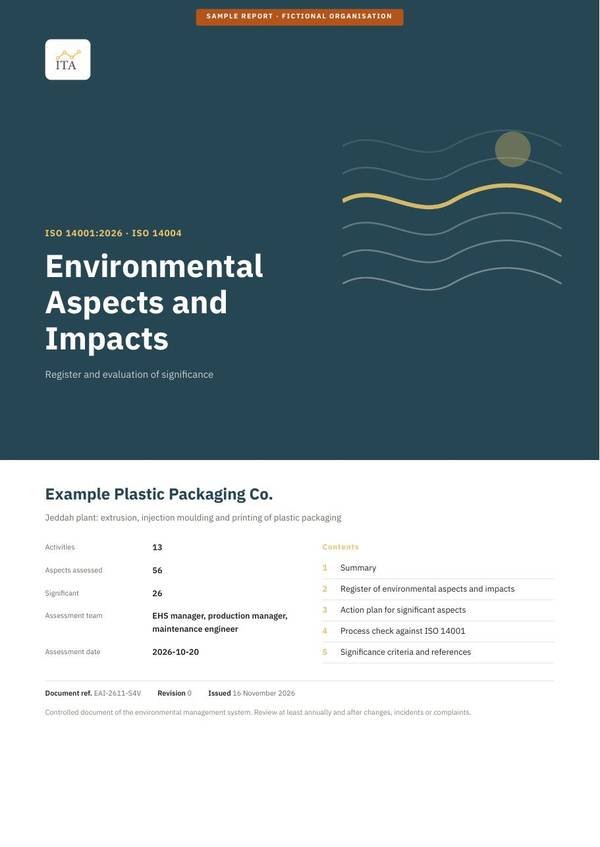
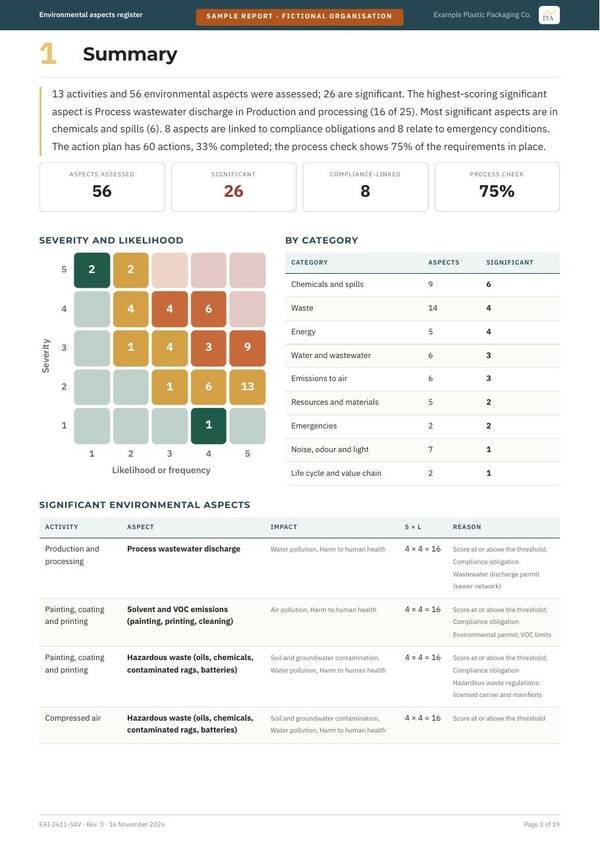
Register of environmental aspects for a fictional plastic packaging plant: summary, severity and likelihood map, significant aspects with the reason for each, the full register by activity with conditions, life cycle stage and obligations, the action plan, the ISO 14001 process check and the criteria.
Use the tool below, then press "Download report (PDF)" to get the same report with your own data. The sample uses fictional data.
Identify the environmental aspects of your activities, products and services and the impacts they can cause, under normal, abnormal and emergency conditions and from a life cycle perspective. Rate each one, see which are significant and why, and plan objectives, controls and monitoring with owners and dates, as ISO 14001 requires.
- 1Set the significance criteria
- 2Choose activities, products and services
- 3Rate each aspect and its impacts
- 4Register of aspects
- 5Action plan for significant aspects
- 6Check the process
Free, no registration. Download a PDF report and an Excel workbook with live formulas, or save your work to a file and continue later.
Loading the environmental aspects tool…
Aspect or impact?
An environmental aspect is the part of an activity, product or service that interacts with the environment: burning diesel in a generator, discharging wash water, storing chemicals. An environmental impact is the change that results: air pollution, contaminated soil, depletion of water. The aspect is the cause and the impact is the effect, so controls act on the aspect.
How the tool works
- Set the significance criteria. Severity and likelihood scales from 1 to 5, a score threshold, and rules that make an aspect significant whatever its score: a compliance obligation, an interested party concern, or an emergency with major consequences.
- Choose activities. 25 activities, processes and services, from offices and canteens to boilers, wastewater treatment, painting, storage tanks, purchasing and products at end of life. Typical aspects are added for each one, and you can add your own.
- Rate each aspect. Confirm the condition (normal, abnormal or emergency), whether you control it directly or only influence it, the life cycle stage, severity and likelihood, any law or permit that applies, and existing controls. The score and the reason for significance update as you go.
- Review the register. Totals, a severity and likelihood map, aspects by category, and the full register that you can filter to significant aspects only.
- Build the action plan. For each significant aspect, suggested objectives, operational controls, monitoring, emergency preparedness, training and supplier controls, with owners, dates and status. Overdue actions are flagged.
- Check the process. Thirteen questions on how the register is kept, reviewed and used, each linked to its ISO 14001:2026 clause.
- Download. Enter your email to download a PDF report and an Excel register with live formulas, in Arabic or English. Save your work to a file and continue later.
Standards and regulations
- ISO 14001:2026: the new edition was published in April 2026 and replaces ISO 14001:2015 and its 2024 climate change amendment. It gives more weight to the life cycle perspective and to environmental conditions such as pollution, biodiversity and resource availability. Certified organisations are expected to transition by 2029. Environmental aspects remain in clause 6.1.2 in both editions: organisations must determine the aspects they can control and influence, their impacts, and which are significant. The 2026 edition adds sub-clause 6.1.4 on risks and opportunities (so planning action becomes 6.1.5) and a new clause 6.3 on planning of changes. Each question in the tool’s process check shows the clause it relates to.
- ISO 14004:2016: guidance on implementing an environmental management system, including practical methods for identifying aspects and evaluating significance.
- Saudi Arabia: the Environmental Law issued by Royal Decree M/165 of 2020 and its executive regulations, enforced by the National Center for Environmental Compliance through environmental permits for activities.
- Egypt: Environment Law No. 4 of 1994, amended by Law No. 9 of 2009, with its executive regulation and environmental impact assessment requirements.
- United Arab Emirates: Federal Law No. 24 of 1999 on the protection and development of the environment, together with the requirements of each emirate’s environment authority.
Related: ISO 14001 consultancy, the Carbon Footprint Calculator and the Gap Assessment Tool.
Frequently asked questions
What makes an aspect significant?
ISO 14001 leaves the method to you, but the criteria must be defined and applied consistently. Most organisations combine a score, usually severity times likelihood or frequency, with rules such as legal requirements and the concerns of neighbours, customers or the regulator. The tool shows the reason each aspect is significant.
Why consider abnormal and emergency conditions?
Many serious impacts happen outside normal operation: start-up and shutdown, maintenance, power cuts, spills, fires and leaks. ISO 14001 requires these conditions to be considered so that you prepare for them.
What is the life cycle perspective?
Looking beyond your fence to the stages you can influence: raw materials, design, transport, the use of your product and what happens at end of life. You are not asked to carry out a life cycle assessment, only to consider the stages you can control or influence.
How often should the register be reviewed?
At least once a year, and whenever activities, products, processes, equipment or legal requirements change, and after incidents or complaints.
Is my data stored?
Your data stays in your own browser while you work. When you download a file we record your email, name and organisation and your totals, so that we can send you the services and course news you agreed to receive. See our privacy notice.
Does the register make my organisation compliant?
No. It is a tool for your team. Compliance depends on how the system is implemented and on the evaluation of compliance with your obligations. ITA helps organisations build and audit ISO 14001 systems; contact us.