
Carbon Footprint Calculator
Free carbon footprint calculator: Scope 1 and 2 from fuel, vehicles, refrigerants, electricity and cooling, Scope 3 step by step, ISO 14064-1 results, targets and a reduction plan, PDF and Excel.

Measure your organisation’s greenhouse gas emissions with the GHG Protocol and ISO 14064-1. Start with Scope 1 and 2, the emissions you control directly, from fuel, vehicles, refrigerants, electricity and district cooling. Then add the 15 Scope 3 categories of your value chain step by step, set a reduction target and build the plan to reach it.
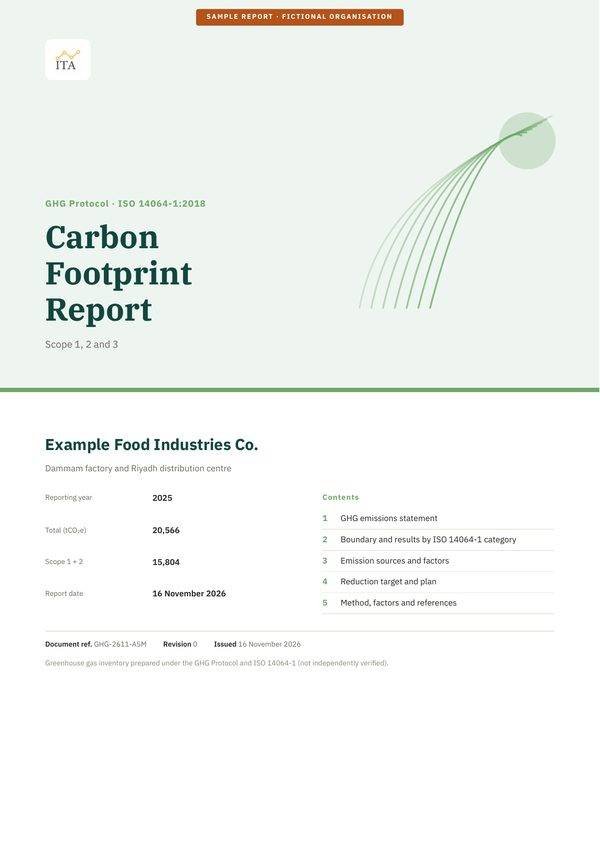
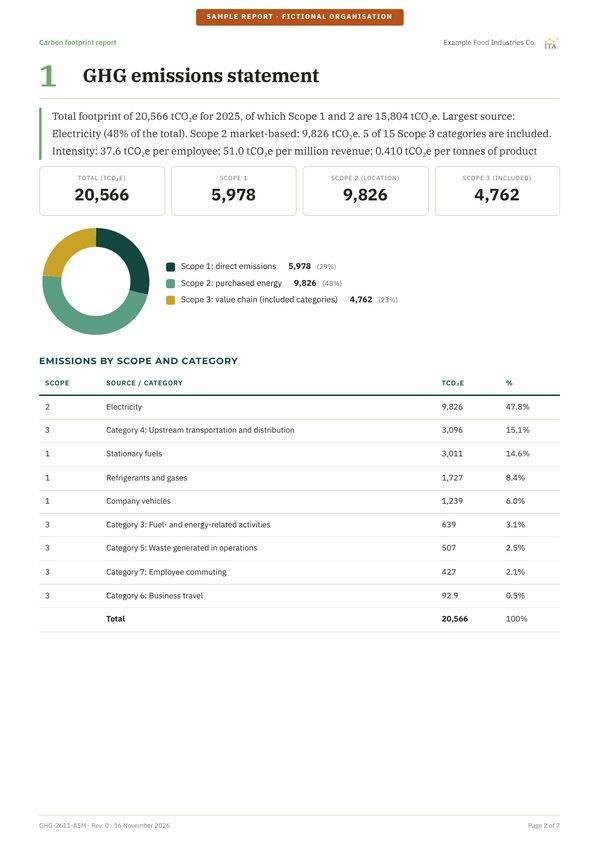
See the report this tool produces
Carbon footprint report for a fictional food manufacturer in Saudi Arabia: GHG statement, results by scope and ISO 14064-1 category, every emission source with its factor, the reduction target and plan, and the method and references.
Use the tool below, then press "Download report (PDF)" to get the same report with your own data. The sample uses fictional data.
Calculate Scope 1 and 2 emissions from fuel, vehicles, refrigerants, electricity and cooling, then add Scope 3 categories step by step. Results follow the GHG Protocol and ISO 14064-1, with a reduction target and an action plan with owners, dates and progress.
- 1Set the boundary
- 2Scope 1: fuels, vehicles, refrigerants
- 3Scope 2: electricity, cooling, heat
- 4Scope 3: add step by step
- 5Results by scope and ISO category
- 6Targets and reduction plan
Free, no registration. Download a PDF report and an Excel workbook with live formulas, or save your work to a file and continue later.
Loading the carbon footprint calculator…
How the calculator works
- Set the boundary. Organisation, sites, reporting year and consolidation approach (operational control, financial control or equity share), and the country for the electricity grid factor.
- Scope 1: direct emissions. Fuels burnt on site (diesel, natural gas, LPG, fuel oil, kerosene, coal), company vehicles by fuel or distance, refrigerant top-ups (R-410A, R-407C, R-404A, R-134a, R-32 and more) and process emissions.
- Scope 2: purchased energy. Electricity by meter or site, district cooling in refrigeration ton-hours, and purchased heat or steam, reported with both the location-based and market-based methods.
- Scope 3: step by step. Switch on each of the 15 categories when you are ready: freight in tonne-km, business travel and commuting, waste by material and treatment, grid losses, and any other category with your own factor. Record why a category is excluded.
- Results. Totals by scope and source, the largest sources, Scope 2 by both methods, intensity per employee, revenue, output or floor area, data quality, and the six ISO 14064-1:2018 categories.
- Targets and reduction plan. Set a base year and target (the default follows the SBTi 1.5°C minimum of 4.2% a year for Scope 1 and 2), choose measures from a library or write your own, apply each to a source, and track owners, dates and progress.
- Download. Enter your email to download a PDF report and an Excel workbook with live formulas, in Arabic or English. Save your work to a file and continue later.
Standards, factors and regulations
- GHG Protocol Corporate Standard, Scope 2 Guidance and Scope 3 Standard: the accounting rules used by the calculator. GHG Protocol and ISO are developing a single consolidated corporate standard, with a public consultation planned for 2027; the calculator will follow it when it is published.
- ISO 14064-1:2018: results are also grouped in its six categories of direct and indirect emissions. Independent verification is carried out under ISO 14064-3.
- Global warming potentials: IPCC Sixth Assessment Report (AR6) 100-year values, as recommended by the GHG Protocol (2024).
- Emission factors: US EPA GHG Emission Factors Hub 2025 for fuels, transport, travel and waste, and IPCC 2006 Guidelines for vehicle methane and nitrous oxide. For Saudi Arabia, the official grid factor of the Designated National Authority (0.568 kg CO₂/kWh); for other countries, an indicative value from the IFI harmonised dataset that you should replace with your utility’s or national authority’s factor.
- Regional requirements: the UAE Federal Decree-Law No. 11 of 2024 on reducing climate change effects (in force since May 2025) requires entities above the threshold to measure and report Scope 1 and 2 emissions; the Saudi Exchange ESG disclosure guidelines and Egypt’s Financial Regulatory Authority decrees 107 and 108 of 2021 ask listed companies to disclose emissions; and IFRS S2 requires Scope 1, 2 and 3 disclosure where it is adopted.
Related: ISO 14064 consultancy, ISO 14001 consultancy and ISO 50001 energy management.
Frequently asked questions
What is the difference between Scope 1, 2 and 3?
Scope 1 is direct emissions from sources you own or control, such as boilers, generators, vehicles and refrigerant leaks. Scope 2 is indirect emissions from the electricity, heat, steam and cooling you buy. Scope 3 is all other indirect emissions in your value chain, from purchased goods and freight to business travel, waste and the use of your products.
Why start with Scope 1 and 2?
They are under your direct control, the data is in your own invoices and meters, and most regulations and the SBTi require them first. Scope 3 is usually larger but needs supplier data, so most organisations add it category by category.
Which grid factor should I use?
Use the factor published by your electricity company or national authority for the reporting year. The calculator uses the official Saudi factor by default; for other countries the default is indicative only. You can enter your own factor on the first tab.
What is market-based Scope 2?
It reflects the electricity you choose to buy: kWh covered by renewable energy certificates or contracts count as zero, and the rest uses your supplier’s factor. The GHG Protocol requires both methods to be reported.
Is my data stored?
Your data stays in your own browser while you work. When you download a file we record your email, name and organisation and your totals, so that we can send you the services and course news you agreed to receive. See our privacy notice.
Is the report a verified carbon footprint?
No. It is a calculation from your own data. For a verified GHG statement you need independent verification under ISO 14064-3. ITA helps organisations prepare their inventory and reduction plan; contact us.